

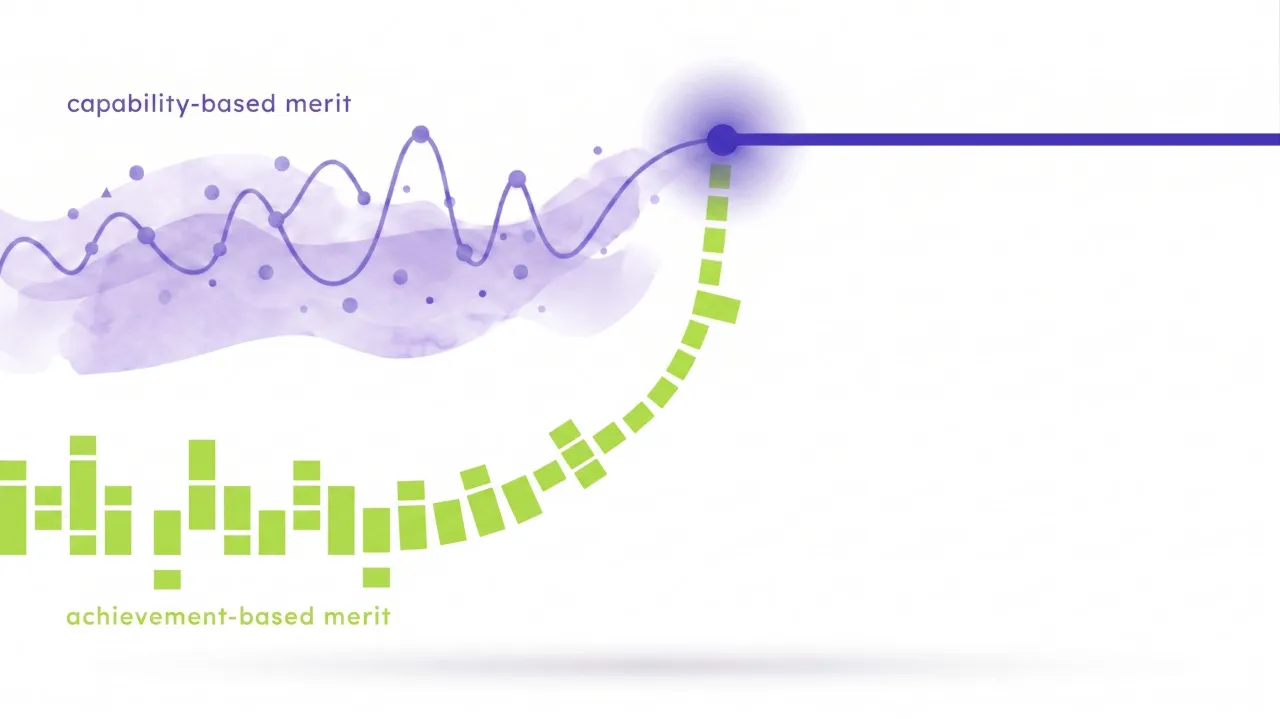
Every talent decision relies on an implicit definition of merit. Work hard, deliver results, earn your way forward. Clean, fair, defensible. The problem is that this version of merit only measures one thing: what someone has already achieved. It says nothing about what they're capable of achieving next. And in environments where the work keeps evolving, future capability matters as much as past achievement, and often more.
The Limits of How We Currently Think About Merit
Our typical go-to approach is achievement-based meritocracy: evaluating people on what they've already done. Roles held, credentials earned, outcomes delivered. This approach feels rigorous and objective. But it carries real blind spots.
It struggles to evaluate people whose roles have changed so fast that their track record is hard to read. It reads opportunity as evidence of ability, treating people who had access to the right environments, networks, and resources as more capable than those who didn't. And it assumes that past success predicts future success.
This approach was built for a more stable world. But that world no longer exists.
The Two Dimensions of Merit
Achievement tells us where someone has been. Capability tells us where they can go. Most organizations only evaluate the first.
The missing dimension is capability-based merit: what someone is capable of becoming. Their learning agility, adaptability, ability to perform under uncertainty, and capacity to keep delivering as contexts change. This is the dimension that is harder to define, and so rarely factors into how we set the standard for success.
There is no universal definition of merit. The right success criteria depend entirely on the role and the context. A role that demands deep domain expertise in a stable environment calls for a different combination of achievement and capability than one that requires navigating constant change. Setting the right threshold means being explicit about which combination of achievement and capability actually predicts success in that specific context.
This reframing preserves performance standards. It doesn't lower the bar or introduce subjectivity. It just makes the bar more complete.
What Good Actually Looks Like
We typically build our decision criteria top-down. We generate a list: skills, competencies, capabilities, behaviors. But before we even figure out how to assess them: is it the right list? How do we know it covers the qualities that will drive the desired outcome?
What if instead we took a bottom-up approach, using the lens of proven success. Every organization has people who have already demonstrated what "great" looks like in a given role. What if we could generate a profile for them? One that captures evidence of both their achievement and their capability, showing the precise combination that drove their success? That profile would be a real evidence-based benchmark, built from the people who have demonstrated it in that context.
Once we have that picture, the question becomes: who else shares it? Who has the right combination of demonstrated achievement and underlying capability to succeed in this role, in this environment, at this moment? That's a question we can actually answer, and it is a far more reliable basis for talent decisions than asking whether someone holds the credentials previously required for this role.
Why This Distinction Matters in Practice
Consider two profiles of proven success.
Profile A: deep track record in a stable domain. Strong credentials, consistent performance, demonstrated mastery. High achievement-based merit. But limited evidence of navigating significant change, learning new domains quickly, or adapting when contexts shifted.
Profile B: a less linear path. Movement across functions, roles with steep learning curves, consistent performance in unfamiliar territory. Strong capability-based merit. But a shorter track record of sustained achievement in any single domain.
Neither profile is inherently better than the other. The question is: what does the role actually demand of whoever succeeds in it?
In a stable environment where deep domain expertise matters, the success criteria should prioritize achievement: depth of track record, proven mastery, consistent delivery in similar territory.
In an environment where roles are being redefined, the success criteria should prioritize capability more heavily. The role may look nothing like what came before. The specific knowledge and experience that defined success in the past may depreciate quickly. What the success criteria need to capture is the ability to learn, adapt, and perform under uncertainty, and the track record that demonstrates it.
Most organizations default to Profile A as their standard, regardless of context, simply because achievement is easier to define and defend. Capability is harder to articulate as a threshold, and therefore rarely gets built into one.
Making It Actionable
To make this work, we need to make it an inseparable part of the way we make talent decisions. It starts with identifying the specific capabilities that actually predict success in a given role. The ones that actually matter given the organization's challenges, not a generic list of competencies based on tribal knowledge. It then requires reliable ways to assess those capacities: evaluating how people actually perform, not how they describe themselves. And it requires the organizational commitment to act on those assessments, even when they conflict with more familiar achievement signals.
Signal or Noise, the previous piece in this series, is about knowing which signals to trust. But even once we've figured that out, the success criteria we use as thresholds matter just as much. Achievement-based criteria are easy to defend. They can be ranked, compared, and justified to skeptical stakeholders. Capability-based criteria require more: the willingness to make a call that goes beyond credentials, and confidence in the ability to measure it.
Organizations that build that confidence will make fundamentally better decisions about who to hire, who to develop, who to promote, and who to place in roles that are still taking shape.
Organizations that don't will keep using yesterday's profile as tomorrow's standard.
The next piece in this series gets into how we can actually build the infrastructure to measure capability at this level of rigor, and what it takes to make that measurement reliable enough to act on.