

How do we ensure our AI investment generates business impact? We invest time, money and focus on AI transformation with an expectation that it will pay back tenfold. At the end of the day, we expect real outcomes. So we transform.
However, transformation is not one thing. It is multi-faceted and focuses on technology, process, compliance, cost, and people. The first four get most of the attention. They have owners, budgets, and dashboards. The people layer usually gets a training program and a mandate to use the tools.
But the people component is where transformation actually succeeds or fails. And inside it there are three layers:
The first is adoption. Did they open the tool? Did they log in this week? This is the easiest thing to measure and the easiest thing to fake. Worse, once it becomes a target, usage and token costs climb while business value stays flat. Deloitte's recent research makes the point clearly. Access to AI tools grew by half in a single year, yet fewer than 60 percent of workers with access use AI in their daily work, and 84 percent of organizations have not redesigned a single job or workflow around it. Adoption tells you someone walked through the door. It tells you nothing about what they did next.
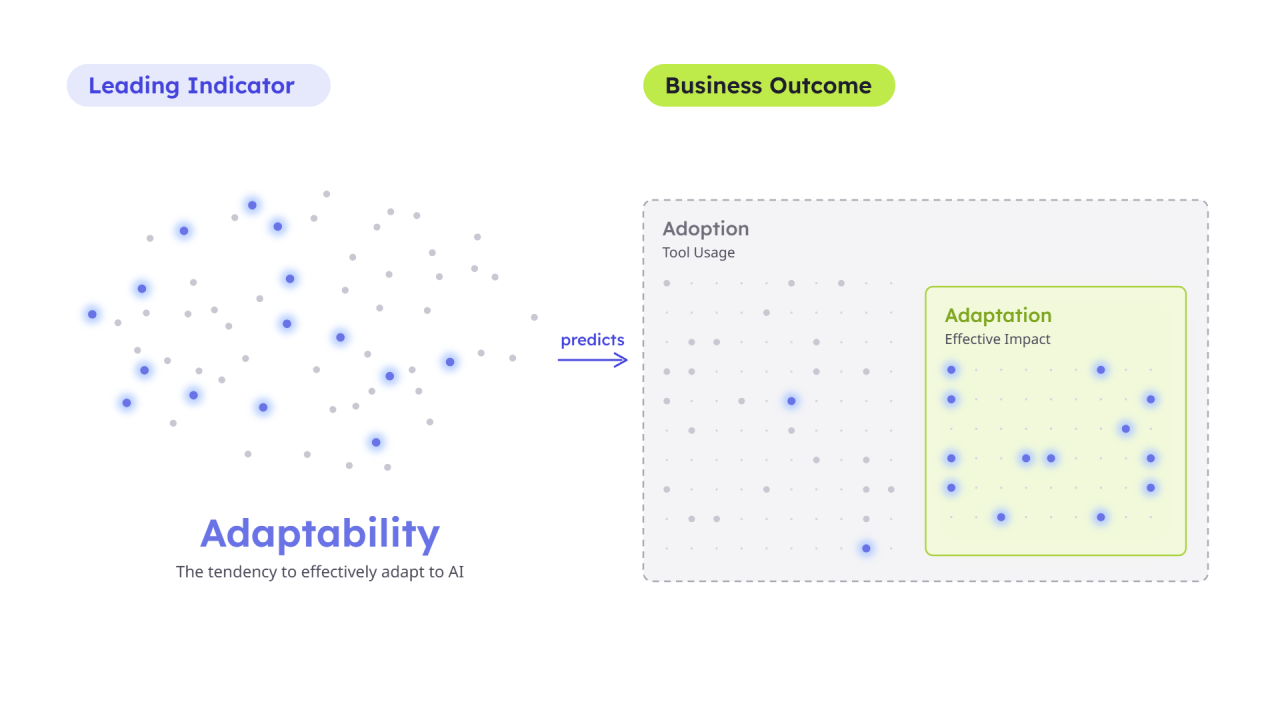
The second is adaptation. Did they change how they work? Did the use of AI improve the output, the decision, the result? This is where business impact starts showing up. It is also much harder to discern. The behaviors that separate adopters from adapters are subtle: judgment about when to trust or challenge AI, experimentation to find value no one has mapped yet, and protecting the human thinking a model cannot replicate.
But there is a third layer underneath both. Adaptability. Adaptation is a behavior. Adaptability is the capacity that produces it. It is how a person handles change. How they respond to cognitive overload. What they do when they hit frustration, ambiguity, or a wall. Whether they push through an obstacle or retreat to the way they worked last year.
Give two people the same tool, the same training, and the same mandate: one reshapes their work, the other logs in on Friday to keep the dashboard green. The difference is rarely what they know. It is what they are capable of.
Until now, the challenge was measuring adaptability. It was perceived as a judgment call, the kind of thing you can only sense about a person, or take their word for it. But it isn't. It can be measured empirically. And that creates a significant advantage: a leading indicator. Adoption and adaptation tell you what already happened. Adaptability tells you what's coming.
If you are deciding who to hire into an AI-critical role, who to reskill, or who to place on the team you cannot afford to get wrong, adoption and adaptation describe the past. Adaptability describes the future.