

For decades, one assumption has anchored every talent decision: Past performance is the best predictor of future performance.
It's intuitive. It's practical. And for a long time, it was true.
But in an era defined by volatility and AI-driven shift, that logic has broken. We are still using 20th-century signals: credentials, years of experience, and polished interviews, to predict 21st-century outcomes.
The problem? Credentials show where someone studied, not how they'll pivot when their industry is disrupted. Experience tells you how long someone has been doing a task, not whether they can master a new one.
When the pace of change was slow, these proxies were "good enough." Today, they are quickly losing relevance.
The Accountability Paradox
The current conversation around AI and talent focuses on replacement. That's the wrong frame.
AI may take on tasks, but it does not take on accountability. That remains human. When five people supported by AI can do the work that once required fifteen, those five carry the full weight of accountability.
As individual leverage increases, the margin for error in talent decisions is shrinking. The cost of getting it wrong is growing. We need to select our people with far greater precision because we are giving them more powerful tools than ever before.
What Actually Predicts Success
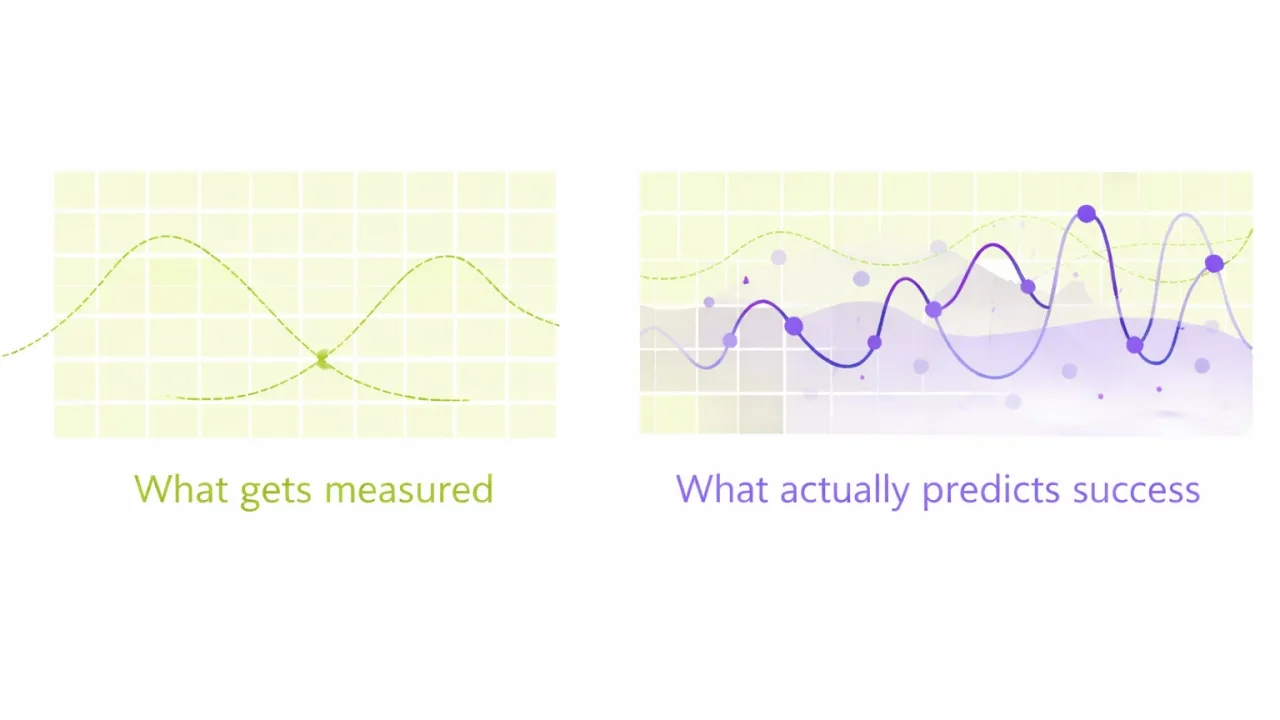
As work becomes more dynamic and less predictable, success depends less on accumulated knowledge and more on underlying capabilities: how someone performs under pressure, learns and adapts, processes incomplete information, and works with others when the stakes are high.
It would be misleading to try to assess these based on credentials, how people present themselves in interviews or self-reported questionnaires. They can, however, be measured as reliable signals by observing how people actually behave, not what they say about themselves.
The problem is that most organizations don't measure these underlying capabilities at all. Instead, we infer them from surface signals, assuming an elite credential must indicate cognitive flexibility, or that years of experience translate into the ability to perform well when things get hard.
The Rigor Gap
There is a striking inconsistency in how we run our organizations today.
When evaluating an investment or a major operational decision, we build models. We identify the variables that actually predict outcomes. We validate assumptions, stress-test scenarios, and quantify uncertainty. We treat risk with extraordinary technical rigor because we know the stakes are high.
Talent decisions carry comparable stakes, arguably higher, because organizational capability lives in people, not spreadsheets. So why do we approach these decisions with far less rigor than we do our capital? The deeper reason is simple: we haven't yet treated human potential as something that can, and should, be modeled with the same precision we bring to financial risk.
The Path Forward
What predicts success is not what you know or what you've done. It's what you're capable of.
Organizations that solve the measurement problem will identify high-potential talent earlier, make promotion decisions based on future readiness rather than past accomplishments, and build leadership pipelines that reflect actual likelihood to succeed. Better talent decisions, made consistently, compound to strengthen the organization. Organizations that don't solve this will keep paying the cost of getting it wrong, without ever quite knowing why.
The good news is that the infrastructure to measure capability rigorously now exists.
The most powerful version of this approach goes one step further. It doesn't just measure capability in the abstract. It models what the right combination of capabilities looks like for a specific need.
This isn't about replacing human judgment with algorithms. It's about giving human judgment something better to work with: rigorous, validated insight into what people are actually capable of, not just what their backgrounds suggest.
The question is no longer whether talent systems need to evolve. They do. The question is whether organizations will build the capacity to measure what actually predicts success, or keep relying on signals that made sense in a world that no longer exists.