

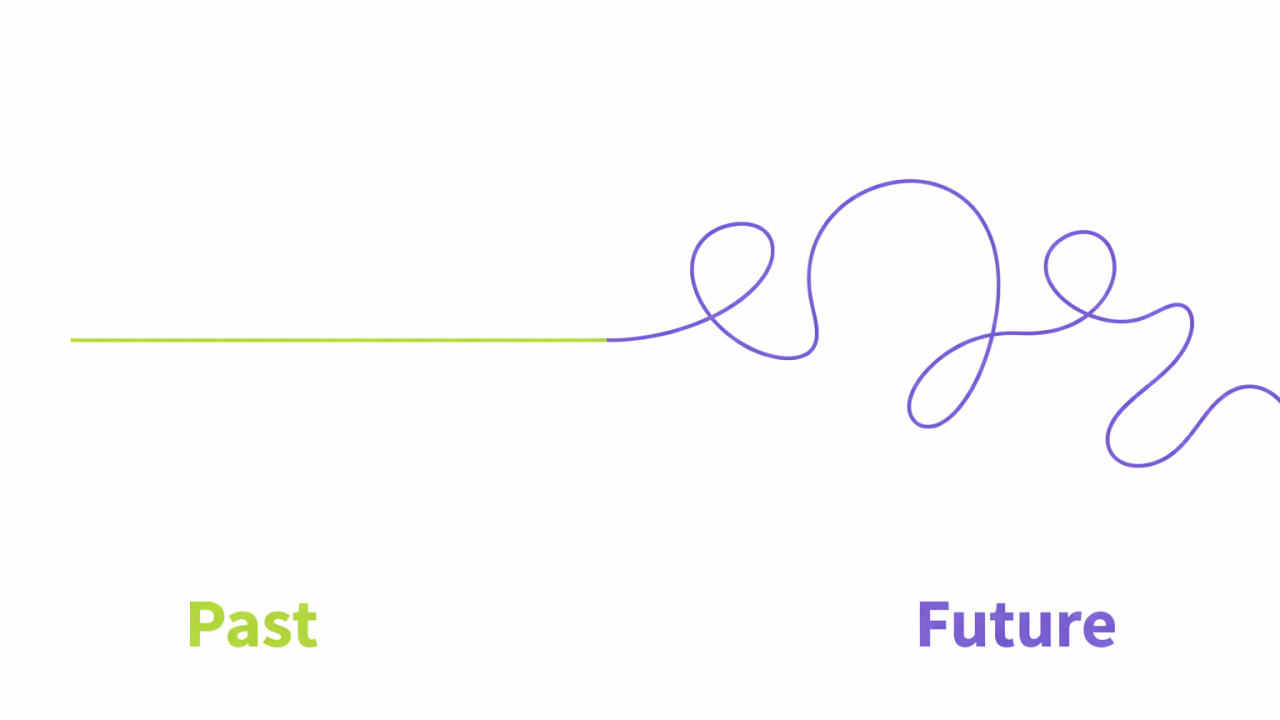
For decades, knowledge and experience were the signals of capability. The more someone had learned and demonstrated, the more reliably you could predict how they'll do next. That was a reasonable assumption, as long as the work itself stayed relatively stable.
It isn't stable anymore. Roles evolve faster than promotion cycles. Skills that took years to build can lose relevance in months.
The problem isn't just that the world is changing. It's that the signals we rely on to evaluate people haven't kept up. We are still measuring what someone knows, in a world where what someone knows has a shorter and shorter shelf life.
Why Skills Alone Aren't Enough
The natural response to this has been a shift toward skills-based frameworks. If credentials are losing relevance, the thinking goes, measure skills instead. Define them, catalogue them, train for them, match them to roles.
It's a reasonable instinct. But it doesn't solve the underlying problem. It just moves it one level down.
Skills change too quickly, fragment too easily, and recombine too unpredictably to function as durable signals. Those that matter today are tool-dependent, context-specific, and short-lived. A skill that is valuable now may be automated, embedded into a platform, or irrelevant altogether within a year.
But the deeper problem isn't the speed of change. It's that a skills-first approach assumes having the skill is the primary constraint. It isn't.
What actually differentiates people in fast-moving environments is something underneath the skills: whether they can learn new systems quickly; adapt their thinking as tasks shift; operate effectively when the path isn't clear; and reconfigure what they know as roles evolve. These aren't skills. They are the capacities that generate skills.
As work keeps changing, skills become the output of those underlying capacities, not the input. Measuring skills reveals what someone has already built. It reveals far less about what they will be able to build next.
That's why we need a better signal.
The Shift from Knowledge to Potential
What stays predictive, even as specific knowledge depreciates, are the underlying traits that shape how someone navigates change: how quickly they learn, how effectively they adapt, how well they make decisions when information is incomplete, and how they bring others with them through disruption.
In other words: potential. Not as a general quality someone either has or doesn't, but as something specific to a context: the capacity to succeed in this role, in this environment, right now.
This doesn't mean ignoring what people have already achieved. Past performance still matters. It provides evidence of capability, work ethic, and the ability to deliver. But when the future looks fundamentally different from the past, what someone is capable of becoming matters more than what they have already mastered.
The question most talent systems are built to answer is: what has this person already done? The question that actually predicts success in a changing world is different: what are they capable of?
Most organizations have no systematic way to answer the second question. Talent systems are built to evaluate knowledge, skills, and past achievement because those are relatively easy to measure. Credentials, years of experience, performance ratings, demonstrated outcomes: these are legible signals. They can be compared, ranked, and defended.
Potential is harder. It requires evaluating how someone responds, not just what they know. It requires predicting performance in contexts that may not yet exist. It requires telling apart people who succeeded because circumstances were favorable from people who succeeded because of underlying capabilities that will transfer to new environments.
And it requires giving those assessments real weight in decisions, even when they conflict with more familiar markers.
That's the measurement challenge. And before we can solve it, we need to face a harder question: even when organizations start using new signals to evaluate talent, how do they know those signals are telling them the truth? That's what the next piece in this series is about.